Blog
Quebec needs industrial heat pumps - ATIS Énergie rises to the challenge
23 August 2025

Blog
23 August 2025
As Canada ramps up efforts to meet ambitious climate targets, one technology remains essential yet underused: the industrial heat pump. Capable of replacing gas or oil boilers in industrial processes, large buildings and district heating networks, it offers an efficient and sustainable solution tailor-made for Canadian realities.
The industrial sector accounts for roughly one third of global CO₂ emissions, two thirds of which come from process heating. This means that industrial heating alone represents over 20% of global emissions, yet industrial heat pumps currently meet only about 5% of global industrial heat demand, mostly in Europe and Asia.
Powered by electricity, these systems can deliver up to three times the thermal energy of the electricity they consume, and sometimes even more, while reducing costs and emissions. They’re especially well-suited to Quebec industries such as agri-food, pulp & paper, and chemicals, which have high thermal demands.
Electricity demand is soaring worldwide, driven by digital growth, electric transportation and expanding industrial activity—and Canada is no exception. This surge is intensifying the global race for efficient electrification technologies like industrial heat pumps.
The global market for industrial heat pumps is projected to grow more than 15% per year through 2030, reaching $11–21 billion, up from $4 billion in 2023. In Europe, heat pumps are expected to cover 15% of district heating and 20% of industrial heating under 200°C by 2030. So why not in Canada?
To succeed, Canada can’t rely solely on foreign suppliers. We need to build our own design and manufacturing capabilities to ensure technological independence.
Making this transition work means creating a collaborative ecosystem that brings together manufacturers, industrial users, consulting engineers and installers. Together, we can develop innovative solutions tailored to local needs while supporting Quebec jobs and expertise.
At ATIS Énergie, that’s exactly what we’re doing. We’ve set out to develop our own industrial heat pumps, designed and built with partners right here in Quebec and across Canada. This is our vision for a strong local ecosystem capable of meeting tomorrow’s technological and climate challenges.
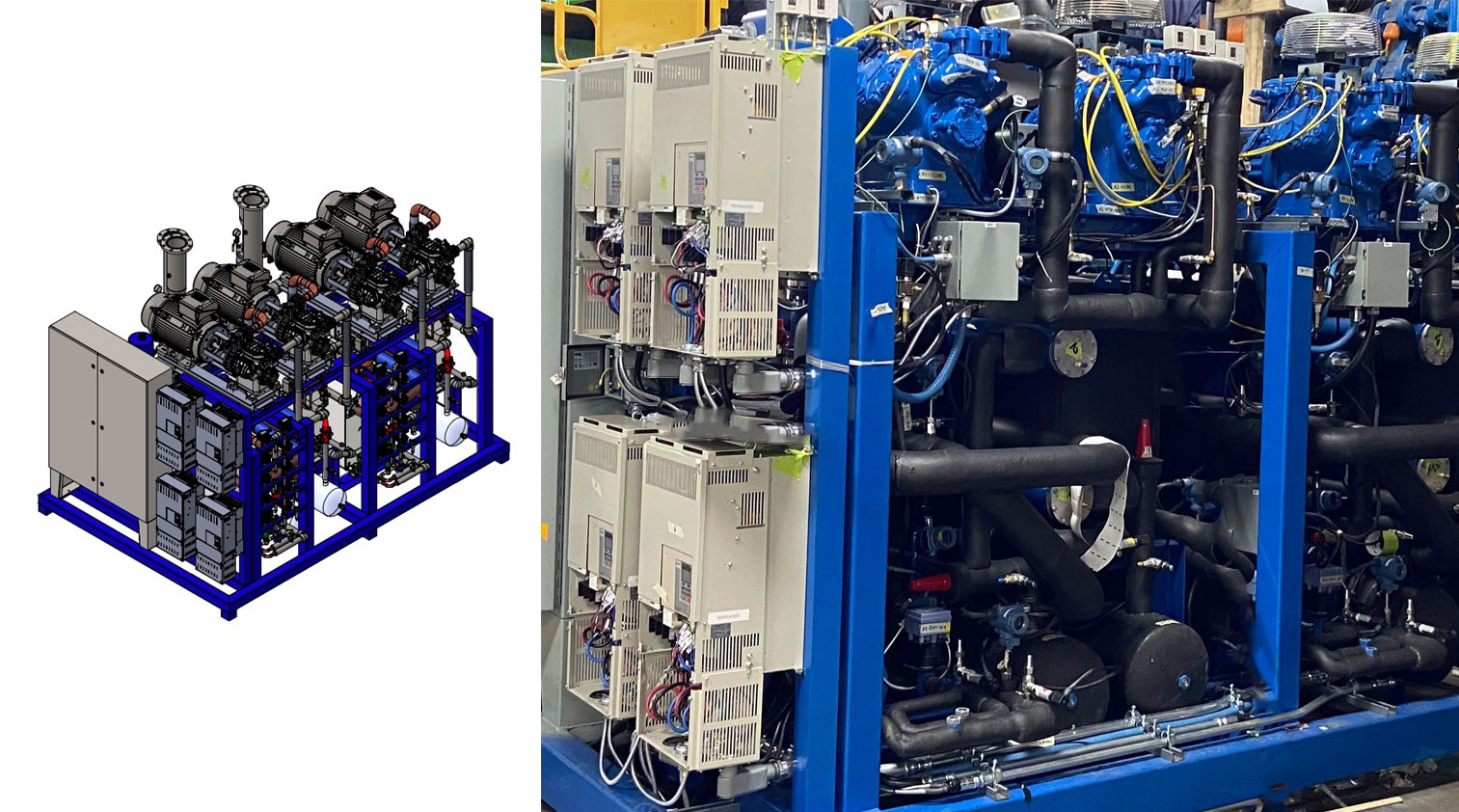
Working in industry for over 20 years, our team has faced countless challenges with the industrial heat pumps available on the market. We’ve repaired, adapted and even rebuilt many of them. Drawing on that experience, we made the strategic decision to design our own heat pumps, manufactured locally by Quebec and Canadian partners.
Today, we offer a full range of industrial heat pumps—from 50 kW/150 kWth up to 600 kW/1,800 kWth per unit—engineered to meet the exacting needs of Quebec’s industrial processes. Learn more about our innovations.

8 April 2026
À travers le dossier spécial agroalimentaire de Les Affaires d'avril 2026, ATIS Énergie partage ses observations de plus de 20 ans sur le terrain : l'énergie est un levier de compétitivité encore trop peu exploité dans le secteur agroalimentaire.
10 February 2025
In an economic context marked by unprecedented pressures, Québec businesses must redouble their efforts to remain competitive. Between the threat of increased export tariffs, trade tensions and the anticipated increase in the cost of electricity or natural gas, it is becoming essential to optimise every available resource. One of the most powerful levers to address these challenges is investment in energy productivity.
31 July 2025
On July 23, 2025, the International Court of Justice (ICJ) issued a landmark advisory opinion on state responsibility when it comes to climate change. This decision, while not legally binding, redefines international environmental obligations and will have profound repercussions for both public policy and industrial practices.